
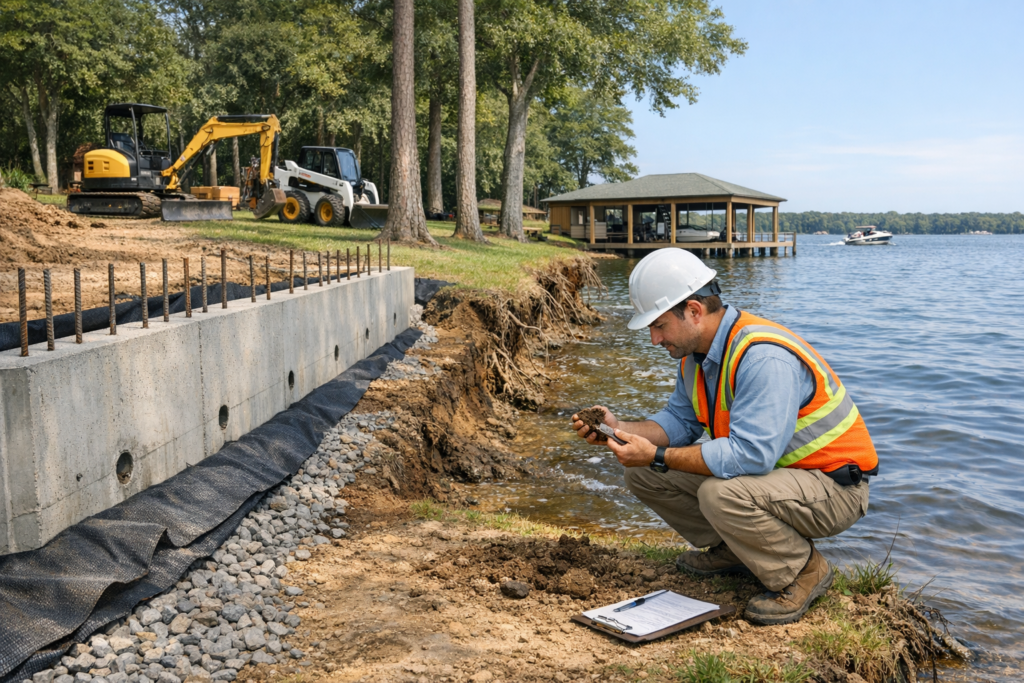
Why Smart Lakefront Property Owners Plan Seawall Installation Before Erosion Starts
Living on the water around Gilmer TX, Lake Tyler, or Lake Palestine is a dream until wave action and shoreline erosion start eating away at your yard, your dock, and your investment. We have seen too many lakefront property owners call us only after they’ve lost ten or twenty feet of shoreline. By then, seawall installation is more complex, more expensive, and sometimes requires rebuilding docks, utilities, or access paths that could have been protected from the start.
When we talk about seawall construction with homeowners, we always start with one key truth: erosion never fixes itself. As wave energy, boat traffic, and changing water levels attack bare soil, the damage accelerates. That’s why planning shoreline protection early is one of the smartest decisions you can make for your lakefront seawall, boathouse, or dock and pier construction projects.
Here are a few things we wish every homeowner in East Texas knew sooner:
– Installing a seawall early means shallower excavation, less disturbed soil, and lower overall cost.
– Adding a retaining wall for shoreline and a riprap shoreline buffer helps protect your lawn, trees, and structures.
– Coordinating seawall construction with boathouse construction and bulkhead installation creates a stronger, longer-lasting shoreline system.
Our passion is helping families in Gilmer TX and the surrounding lakes enjoy their property for decades, not just a few seasons. When we design seawall installation, we think about kids playing by the water, boats coming and going, fishing off the pier, and how your shoreline will look and perform 20+ years from now. Planning now can save you from emergency erosion control solutions later.
Step One: Shoreline Assessment and Design Secrets We Use on Every Project
Before we put a single piece of concrete, steel, or vinyl in the ground, we start with a detailed shoreline assessment. This is where a lot of DIY projects go wrong. On the surface, your shoreline might look simple—a stretch of dirt meeting the water—but we know every bank in East Texas behaves differently based on soil type, slope, water depth, and wave action.
What We Look For During a Professional Shoreline Assessment
When we walk your property, we are studying details that many people never think about, including:
– Soil composition and soil stabilization needs (clays, sands, organic layers).
– Existing erosion patterns: undercut banks, slumping, or exposed roots.
– Wave energy from boat traffic, prevailing winds, and storm patterns.
– Water level changes that increase hydrostatic pressure behind the wall.
– Access points for equipment and material staging for safe site preparation.
We often recommend bringing in a structural engineer for more complex sites, especially where there are steep slopes, large existing structures nearby, or heavy load-bearing capacity requirements (like a large boathouse or multi-slip dock and pier construction). Together, we review engineering and design options that match your budget and long-term goals.
For many lakefront property owners, the first big decision is choosing the right style of shoreline protection:
– Concrete seawall for maximum durability and protection in high-wave areas.
– Steel seawall where space is tight and we need strong, thin profiles.
– Vinyl seawall for a balance of performance, clean appearance, and corrosion resistance.
– Riprap shoreline for natural-looking erosion control solutions in lower-energy areas.
Each option is part of a bigger system that may also include a retaining wall for shoreline, bulkhead installation, and integrated drainage features.
Engineering and Design Details Homeowners Rarely Hear About
On a well-designed East Texas seawall installation, the part you see is just the tip of the iceberg. The strength and longevity come from the “hidden” components behind the wall. These are the secrets we build into almost every seawall installation:
– Geotextile fabric: We place geotextile fabric behind the wall to separate soil from rock backfill, reduce washout, and improve soil stabilization.
– Tie-backs / deadman anchors: For taller or highly loaded walls, we install tie-backs or deadman anchors that extend into stable soil behind the wall and lock everything together.
– Drainage weep holes: Properly spaced weep holes relieve hydrostatic pressure so water doesn’t build up behind the wall and push it forward.
– Engineered backfill: We use clean stone, sometimes mixed with suitable soils, compacted properly to support load-bearing capacity and drainage.
Ignoring any of these details is one of the fastest ways to shorten the life of a lakefront seawall. We have replaced many failing walls where there was no geotextile fabric, no tie-backs, and no drainage weep holes. From the front, they looked fine for a few years—until cracks, bulges, or leaning started to show.
By taking the time to perform a thorough shoreline assessment and partner with a structural engineer when needed, we can design a seawall installation that’s tailored to your specific property on Lake Tyler, Lake Palestine, or any of our Gilmer-area lakes.
Material Choices, Site Preparation, and How We Build a Long-Lasting Seawall
Once we have a solid plan and the right engineering and design, the next step is execution. This is where our experience as a lakefront construction company really matters. A great design only works if site preparation and installation are done correctly from day one.
Choosing Between Concrete, Steel, Vinyl, and Riprap Shoreline Systems
In East Texas, we typically see four primary shoreline protection systems, often combined together:
– Concrete seawall:
We recommend a concrete seawall when you need serious strength and durability, especially along areas with strong wave action or where you’re supporting heavy structures. When poured and reinforced correctly, a concrete seawall can handle high hydrostatic pressure and repetitive wave energy for decades.
– Steel seawall:
A steel seawall is slim but strong, making it ideal where yard space is limited. We drive steel sheets deep into stable soils, then tie them back and cap them with steel or concrete. With proper coatings and soil stabilization measures, steel seawalls perform well in many East Texas waterways.
– Vinyl seawall:
A vinyl seawall offers excellent corrosion resistance and a clean look. For many lakefront property owners, vinyl is a long-lasting option that resists rot and rust. We still treat it as a structural system with tie-backs, geotextile fabric, and correct backfill to handle hydrostatic pressure.
– Riprap shoreline:
Riprap shoreline is often used either in front of a vertical wall or as a standalone solution on lower banks. The rock layer absorbs and diffuses wave energy, reducing direct impact on your soil or wall. In some coves and mild wave zones around Gilmer TX and Lake Tyler seawall installation sites, a well-designed riprap slope with geotextile fabric underneath can be a very effective erosion control solution.
Often, our best projects combine these elements—for example, a vinyl seawall with riprap at the toe to break wave action, or a concrete seawall tied into a retaining wall for shoreline where the yard rises quickly from the water.
Site Preparation and Installation Steps Homeowners Don’t See
From the homeowner’s perspective, seawall construction might look like machines, noise, and quick transformation. Behind the scenes, we are following a sequence of site preparation and installation steps that protect your property and ensure long-term success:
1. Site preparation and access
We plan access routes carefully to protect your landscaping and existing structures. Sometimes we work from the water with barges or specialized equipment, especially for Lake Palestine seawall installation projects where shore access is limited.
2. Temporary erosion control
We may place silt fences, temporary riprap, or other erosion control solutions to keep your shoreline and neighbors’ properties safe during construction.
3. Excavation and grading
We excavate to the required depth for the wall, often below the frost line to reduce damage from freeze–thaw cycles. Even in East Texas, freeze–thaw cycles and shifting soils can impact stability, so we need to account for that.
4. Installing the wall system
– For a concrete seawall, that means forming, reinforcing with rebar, and pouring concrete to the engineered specifications.
– For steel or vinyl seawalls, we drive panels to the required depth, then align and secure them.
5. Tie-backs and deadman anchors
We install tie-backs or deadman anchors into the stable soil behind the wall and connect them to the wall system, effectively “anchoring” the wall into the bank. This dramatically improves load-bearing capacity.
6. Geotextile fabric and backfill
We line the backside of the wall with geotextile fabric, then install proper backfill stone and compact it in layers. This combination handles drainage, reduces soil loss, and controls hydrostatic pressure.
7. Drainage weep holes and finishing
We add correctly placed drainage weep holes to relieve water pressure, install caps, blend the grade into your yard, and restore any disturbed areas. If we are coordinating dock and pier construction or boathouse construction, we integrate those foundations and supports at this stage.
Our goal is always the same: build a complete shoreline protection system, not just a pretty wall. When everything from geotextile fabric to drainage weep holes is working together, your seawall installation has a much better chance of outlasting shifting soils, storms, and daily use.
Permitting, Regulations, and Local Secrets for East Texas Seawall Installation
One of the biggest surprises for many homeowners is how involved permitting and regulations can be for shoreline work. We hear stories all the time from lakefront property owners who started small DIY bulkhead installation or a “temporary” retaining wall for shoreline, only to get a visit from the county, state, or HOA. Fixing regulatory issues can be costly and frustrating, which is why we guide our clients through this process right from the start.
What You Need to Know About Shoreline Permitting in Gilmer TX and Nearby Lakes
Every lake and jurisdiction has its own rules. Lake Tyler seawall installation and Lake Palestine seawall installation may be governed by different entities than smaller private lakes near Gilmer TX. As a local lakefront construction company, we pay close attention to:
– Shoreline permitting (county / state / HOA) requirements for structures near the waterline.
– Setback rules and maximum encroachment into the water.
– Approved materials for seawall construction, riprap shoreline, and docks.
– Environmental protection standards for fish habitat, vegetation, and water quality.
We always recommend that homeowners:
– Contact the governing body for their lake before starting any work.
– Review HOA guidelines for shoreline protection and boathouse construction.
– Keep clear records of permits, inspections, and approvals in case of future property sales.
When we handle a seawall installation project, we coordinate with the structural engineer, local officials, and inspectors so the project meets not only today’s permitting and regulations but also likely future expectations as rules evolve.
Designing for Long-Term Safety, Stability, and Maintenance
True value in seawall installation isn’t just passing inspection today; it’s having a shoreline that still looks and performs well 10, 20, or 30 years from now. We design and construct with long-term performance in mind, especially around:
– Soil stabilization
We know East Texas soils can be soft, expansive, or saturated. That’s why we rely on geotextile fabric, proper compaction, and sometimes additional soil stabilization measures behind the wall.
– Managing hydrostatic pressure
Without proper backfill and drainage weep holes, hydrostatic pressure can build up and push the wall forward or cause cracking. We design our lakefront seawalls to allow water to drain safely while keeping soils in place.
– Handling wave energy and boat wake
In high-traffic areas on Lake Tyler and Lake Palestine, wave energy is a serious factor. We may recommend riprap shoreline at the toe of the seawall, or a stepped design, to help absorb and dissipate wave action instead of letting it pound directly on the wall.
– Integrating docks, piers, and boathouses
When we tie seawall construction together with dock and pier construction and boathouse construction, we can create a safer, stronger system overall. Piers, pilings, and walls can share design assumptions about load-bearing capacity, wave action, and soil conditions.
We also talk with homeowners openly about maintenance:
– Inspect your lakefront seawall annually for cracks, leaning, or erosion at the ends.
– Clear debris from drainage weep holes so they continue to relieve hydrostatic pressure.
– Watch for signs of soil settlement behind the wall and address them early.
If you want to dive deeper into the world of seawalls, the U.S. Army Corps of Engineers and various extension services publish useful shoreline protection resources that we often review when studying new techniques and materials.
How to Choose the Right Partner for Seawall Installation in Gilmer TX
Not all contractors approach seawall installation with the same care and expertise. As a specialized lakefront construction company, we know how important it is for homeowners to choose a team that understands both the structural and environmental sides of shoreline work.
Questions to Ask Before You Hire a Lakefront Construction Company
When we meet with homeowners around Gilmer TX, we encourage them to ask tough questions—not just of us, but of any contractor they interview:
– How many seawall construction projects have you completed on local lakes?
– Can you show examples of concrete seawall, steel seawall, vinyl seawall, and riprap shoreline projects you’ve built?
– Do you work with a structural engineer for design and load-bearing capacity calculations when needed?
– How do you handle shoreline permitting (county / state / HOA) and inspections?
– What specific erosion control solutions do you recommend for my shoreline conditions?
– Will my project include geotextile fabric, tie-backs / deadman anchors, and drainage weep holes, and how will those be designed?
The answers will quickly separate true specialists from general contractors who occasionally work at the water’s edge. A quality team will be transparent about their methods, materials, and past projects and will discuss soil stabilization, hydrostatic pressure, and wave action in a way that makes sense to you.
What We’ve Learned From Years of East Texas Seawall Installation
Over years of working on lakefront seawall and bulkhead installation projects around Gilmer TX, Lake Tyler, and Lake Palestine, we’ve learned a few lessons that guide everything we do:
– Every shoreline is unique
We never copy-paste a design from one property to another. Our seawall installation approach always starts with a fresh shoreline assessment and engineering and design conversation tailored to your soil, slope, and wave energy.
– The “hidden” details decide whether a wall fails or thrives
Homeowners usually focus on the visible face of the wall. We focus on what’s behind it—geotextile fabric, tie-backs, backfill, and drainage weep holes—because that’s what keeps the wall standing.
– Integrating all waterfront elements is more efficient and more durable
Combining seawall construction with dock and pier construction and boathouse construction allows us to design a complete waterfront system. That often saves time and money while creating a more attractive and functional shoreline.
– Planning early is always cheaper than emergency repairs
We’ve seen properties where erosion advanced so far that driveways, patios, and even foundations were threatened. Proactive East Texas seawall installation at the early signs of erosion would have cost a fraction of the later repair bills.
As proud members of this community, our passion is helping lakefront property owners create safe, beautiful shorelines that stand the test of time. Whether you’re on a busy stretch of Lake Palestine or a quiet cove near Gilmer TX, we bring the same attention to detail and commitment to quality.
If you’re ready to protect your shoreline, now is the best time to act. Reach out to us at https://solid5construction.com/ so we can schedule a site visit, discuss your goals, and design a seawall installation that will protect your property, enhance your view, and give you peace of mind for years to come.